
How AI and Automation Are Truly Revolutionizing Your Daily Life and Business
Artificial intelligence (AI) is on everyone’s lips. It’s spoken of as a revolution, a technological tidal wave that will change everything. But beyond the headlines and sometimes abstract promises, what can it concretely do for you? How do you move from concept to action?
For years, I navigated the digital world, juggling dozens of tools, spreadsheets, and manual processes. I remember the hours spent copy-pasting data, sorting emails, and trying to guess the next market trends. It was necessary work, but rarely rewarding. Today, the way I work, create, and make decisions has been profoundly transformed. This transformation has a name: intelligent automation, the powerful marriage of AI and business processes.
This article is not a mere list of AI’s achievements. It is a practical guide, a sharing of experience intended to show you, with specific and applicable examples, how this technology can become your greatest ally to boost your productivity, multiply your creativity, and sharpen your strategy.
1. The Foundation: Intelligent Automation, Your New Operational Superpower
Before we talk about complex strategies, let’s start with the basics: freeing up your time. Automation involves building bridges between the applications you use every day so they can work for you, without your intervention.
The classic example, pushed to its maximum potential:
Imagine you’re a consultant and a new prospect fills out the contact form on your website.
-
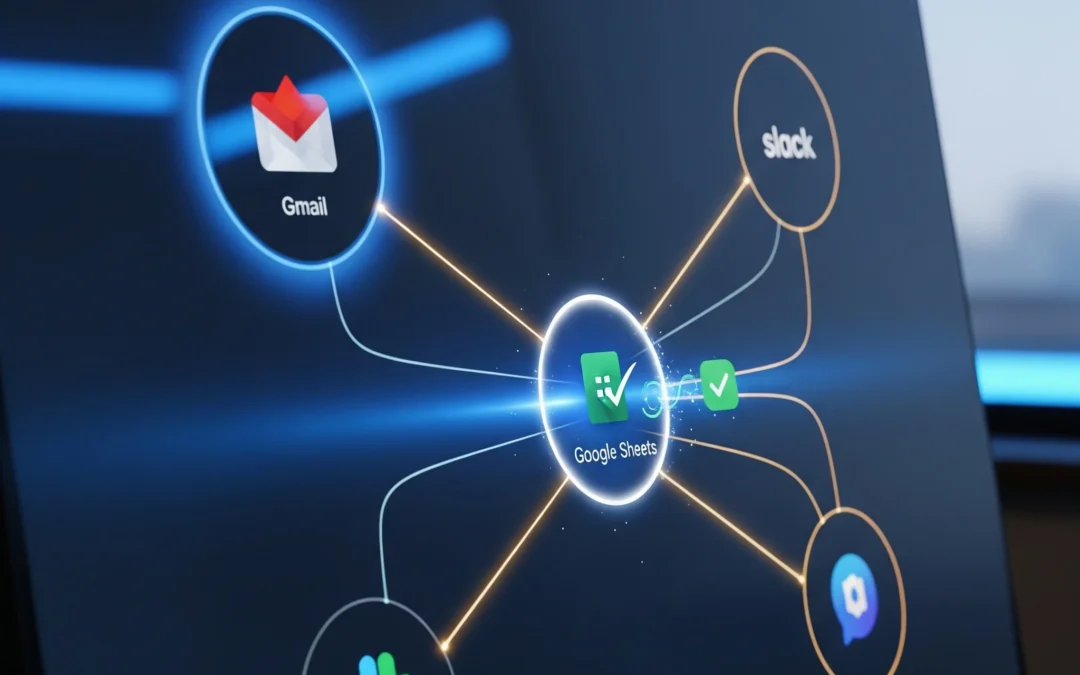
The Manual Scenario: You receive an email. You open your CRM to create a new contact record. You open your tracking spreadsheet to add a new row. You open your calendar to block a time slot for a follow-up call. You open Slack to inform your team. Five manual actions, a waste of time, and a risk of error at every step.
-
The Automated Scenario with a No-Code Platform (like Make or Zapier):
-
The Trigger: « When a new form is submitted on Webflow/Wordpress. »
-
Action 1 (CRM): The tool’s AI automatically extracts the name, email, and message. It instantly creates a new contact record in your CRM (HubSpot, Salesforce) and places it in the « New Prospect » pipeline.
-
Action 2 (Communication): Simultaneously, a message is sent to a dedicated Slack channel: « 🚀 New Prospect: [Prospect’s Name] – [Subject of message]. » Your team is informed in real-time.
-
Action 3 (Project Management): A task is automatically created in your project management tool (Asana, Trello) and assigned to the right person, with a due date of D+1 for the first contact.
-
Action 4 (Personalization): A generative AI analyzes the prospect’s message to deduce their primary need (e.g., « SEO, » « Website Creation »). It then drafts a personalized email response, which you only need to approve, already suggesting a link to a relevant case study.
-
In just a few seconds, this automated workflow has accomplished what would have taken you 10 minutes, error-free and with a touch of intelligence. That is the power of Robotic Process Automation (RPA). Multiply this by the number of repetitive tasks in your day, and you’re no longer measuring the savings in minutes, but in workdays per year.
2. Generative AI: Become an Augmented Content Creator
Creativity was once considered the unbreachable fortress of humanity. Generative AI didn’t storm the fortress; it opened its doors to everyone. Whether you’re a marketer, an entrepreneur, or an artist, it acts as a super-powered creative co-pilot.
Concrete Example: Creating an SEO-Optimized Blog Post from A to Z in Record Time.
My content creation process has radically changed. Here’s how I use AI as a strategic partner:
-
Phase 1: Ideation and SEO Strategy. I no longer ask an AI like ChatGPT to « Give me blog post ideas. » I give it a role and context: « Act as an expert in SEO content strategy. My audience is made up of SME managers in the construction sector. My main keyword is ‘digital transformation construction’. Generate 5 blog post ideas with a unique angle (e.g., ‘How to reduce construction site costs with digital tools’), each with a potential catchy title and 3 questions my audience is asking. » The AI delivers a strategic foundation, not just a list of ideas.
-
Phase 2: Structuring and Detailed Outline. Once I’ve chosen an idea, I continue: « For the idea ‘How drone-based site monitoring optimizes profitability’, create a detailed article outline with an H1, H2, H3 structure. Include subsections on benefits, costs, equipment selection, and regulatory aspects. Suggest secondary keywords to integrate into each part. » I thus obtain the complete skeleton of my article, already optimized for search engines.
-
Phase 3: Assisted (Not Replaced) Writing. I don’t use AI to « write the article. » I use it as a research and writing assistant. For each section, I can ask it to summarize complex information, rephrase a paragraph to be more impactful, or find statistics to support my points. I maintain full control, adding my anecdotes, my expertise, my voice. The AI handles the « heavy lifting »; I focus on the added value.
-
Phase 4: Creating Unique Visuals. An article without visuals is less engaging. Instead of spending hours on stock photo sites, I use a tool like Midjourney. The secret is prompt engineering. I don’t just ask for « a drone on a construction site. » I am specific:
Prompt: /imagine prompt: a photorealistic photo of a modern quadcopter drone flying over a construction site at sunrise. The light is warm and golden, creating long shadows. In the background, a crane and the structure of a building under construction. Cinematic style, high definition, –ar 16:9
In 60 seconds, I get a unique illustration image, perfectly aligned with my content, that no one else has.
-
Phase 5: Repurposing and Promotion. Once the article is published, I entrust the first draft of the repurposing to the AI: « From this article, extract 5 key points for a LinkedIn carousel. Write 3 engaging tweets with relevant hashtags. Finally, write a short script (1 minute) for a TikTok/Reel video that summarizes the main idea. »
This process, which once took several days, can be condensed into a few hours. The quality is higher because I can focus on strategy and personalization rather than on time-consuming tasks.
3. Predictive Analysis: Anticipating the Future to Make Better Decisions
Here, we enter a dimension where AI becomes a true strategic asset. It no longer just executes tasks; it analyzes, interprets, and predicts.
A telling example: Managing an e-commerce store.
An e-commerce manager often navigates by sight, relying on intuition and past sales data. AI brings a 360-degree view.
-
Dynamic Customer Segmentation: Instead of creating manual segments (« women, 25-35 years old »), an AI algorithm can analyze thousands of data points (purchase history, products viewed, time on page, visit frequency) to create dynamic and ultra-precise customer « clusters. » For example: « night shoppers interested in eco-friendly products who respond to email promotions. » You can then send them perfectly targeted offers.
-
Demand Forecasting: This is the nightmare of every e-commerce owner: running out of stock on a best-selling product or overstocking a product that doesn’t sell. Predictive analysis models can analyze your historical sales, cross-reference them with seasonal trends, upcoming events (Christmas, Black Friday), and even external data (weather, social media trends) to predict with formidable accuracy the quantities to order. The result: optimized inventory, less capital tied up, and better customer satisfaction.
-
Churn Prevention: AI can detect the faint signals that indicate a customer is about to leave you (decrease in purchase frequency, viewing of unsubscribe pages, etc.). By identifying these « at-risk » customers, the system can automatically trigger a retention action: a personalized email with a special offer, a survey to understand their dissatisfaction, etc. You act before it’s too late.
4. AI as a Strategic Brain: Revolutionizing Entire Industries
The ultimate power of AI is revealed when it is used to solve problems of a complexity inaccessible to the human mind. The FDA statistic, approving 223 medical devices incorporating AI in 2023 compared to only 6 in 2015, is just the tip of the iceberg.
-
In Healthcare: A human radiologist, even an expert, has experience limited to a few tens of thousands of medical images. An AI model (a convolutional neural network) can be trained on millions of MRIs, CT scans, or X-rays. It learns to detect micro-anomalies, patterns of early-stage tumors, often invisible to the naked eye. AI does not replace the doctor; it augments them, acting as a tireless and extraordinarily perceptive « second pair of eyes, » making medical diagnosis faster and more reliable.
-
In Finance: Beyond algorithmic trading, AI is the backbone of real-time fraud detection. Every time you use your credit card, algorithms analyze the transaction in milliseconds (amount, location, time, merchant type) and compare it to your habits. If an anomaly is detected, the transaction is blocked, and you receive an alert. Managing this volume and speed manually would be simply impossible.
Conclusion: Your Next Step in the Age of AI
Artificial intelligence is not a passing trend; it is the new electricity. It is a fundamental force that is redrawing the boundaries of what is possible. As you have seen, its potential goes far beyond chatbots or simple email automation. It’s about completely rethinking our methods of working, creating, and decision-making.
The biggest risk today is not that AI will replace us, but that we will be outpaced by those who know how to use it. It’s not about becoming an expert in code or algorithms, but about cultivating a new skill: the ability to identify a problem and ask, « How could AI help me solve this more effectively? »
So, I ask you the question again, but with a new perspective: looking at the processes that slow down your day, the decisions you make by instinct, or the creative ideas you don’t have time to bring to life… What will be the first intelligent building block you put in place? The only limit is your willingness to start.
News
Social media automation simplifies your life
As a SEO expert passionate about web dynamics for over fifteen years, I've seen countless strategies come and go. But if there’s one that has radically transformed the way I work, and the way my clients work, it's social media automation. I still remember my early...

The Winning Duo for Creating Passive Income
UNLOCK YOUR FINANCIAL FREEDOM: THE ULTIMATE GUIDE TO PASSIVE INCOME WITH AMAZON AFFILIATION (AI & AUTOMATION) Hello to all the free and ambitious spirits out there! Are you dreaming of passive income that works for you while you live your life? Just imagine...

Create an automated affiliate site
CREATE AN AUTOMATED AFFILIATE WEBSITE: MY STEP-BY-STEP GUIDE Hello everyone! Today, I'm going to talk to you about a strategy I've implemented to generate passive income online: creating an automated affiliate website. Far from promises of quick riches, I'll share my...
How much does a website cost ?
How Much Does a Website Cost in 2025? Creating a website, whether simple or complex, is a crucial step for any business or individual wishing to establish an online presence. In 2025, the cost of creating a website can vary significantly depending on several factors....

Visual Marketing and AI: Create Impactful Campaigns That Captivate Your Audience
In the ever-evolving world of digital marketing, integrating artificial intelligence (AI) into visual marketing signifies a radical transformation. It is a quiet revolution that is upending the way we create, distribute, and optimize digital campaigns. Today, I...

AI the New Engine of Web Factories : Revolutionize Your Website Creation Process
AI the New Engine of Web Factories : Revolutionize Your Website Creation Process For some time now, artificial intelligence has taken over the digital world, and among its many areas of application, the Web Factory sector is no exception. I have witnessed firsthand...

7 Concrete Applications to Outperform Your Competitors
Marketing and AI in 2025 : 7 Concrete Applications to Outperform Your Competitors In 2025, the rise of artificial intelligence (AI) in marketing is inevitable. With 92% of companies ready to invest in generative AI, this revolutionary technology is now at the core of...